
焦糖
SC to pronounce verdict on Karnataka Hijab ban tomorrow_我的网站

一 | New Delhi, Oct 12 (UNI) Supreme Court will tomorrow pronounce its judgement on a batch of petitions challenging the Karnataka High Court order upholding the ban on wearing a Hijab in educational institutions.
A two-judge bench of the Supreme Court, headed by Justice Hemant Gupta and also comprising Justice Sudhanshu Dhulia, on September 26, had reserved its order, after hearing from all the parties -- 23 petitioners, their lawyers, Karnataka government -- for 10 days.
The Supreme Court will tomorrow pronounce the verdict on 23 petitions, including that of, Aishat Shifa, and others.
Karnataka government had argued in the Supreme Court that it had the authority to issue an order to educational institutions to follow the discipline of wearing the prescribed school uniforms.
Senior advocate Dushyant Dave, appearing for the students/ petitioners, argued that fundamental rights, freedom to choose to what to wear and freedom of faith would not diminish inside a classroom.
The lawyeres for the students -- Devadatt Kamat, Dr Rajeev Dhavan amd Dishyant Dave -- submitted to the Apex Court that the Karnataka State government had not presented even a single shred of evidence to support their claim that a few students wearing hijab to their classrooms in addition to their respective uniforms violated public order, health and morality.
The lawyers further said that the Karnataka government had not provide any material to support their claim that wearing hijab infringed on the fundamental rights of other students.
UNI SM GNK。

"I've come to nature's air conditioner."
That was the reaction of a Spanish tourist visiting southwest China's Yunnan Province this summer. Before arriving, he had been enduring temperatures of around 40 degrees Celsius. But when his flight landed in Kunming and he stepped out into the breeze, the relief was immediate. His trip in search of cooler weather had proved well worth it.
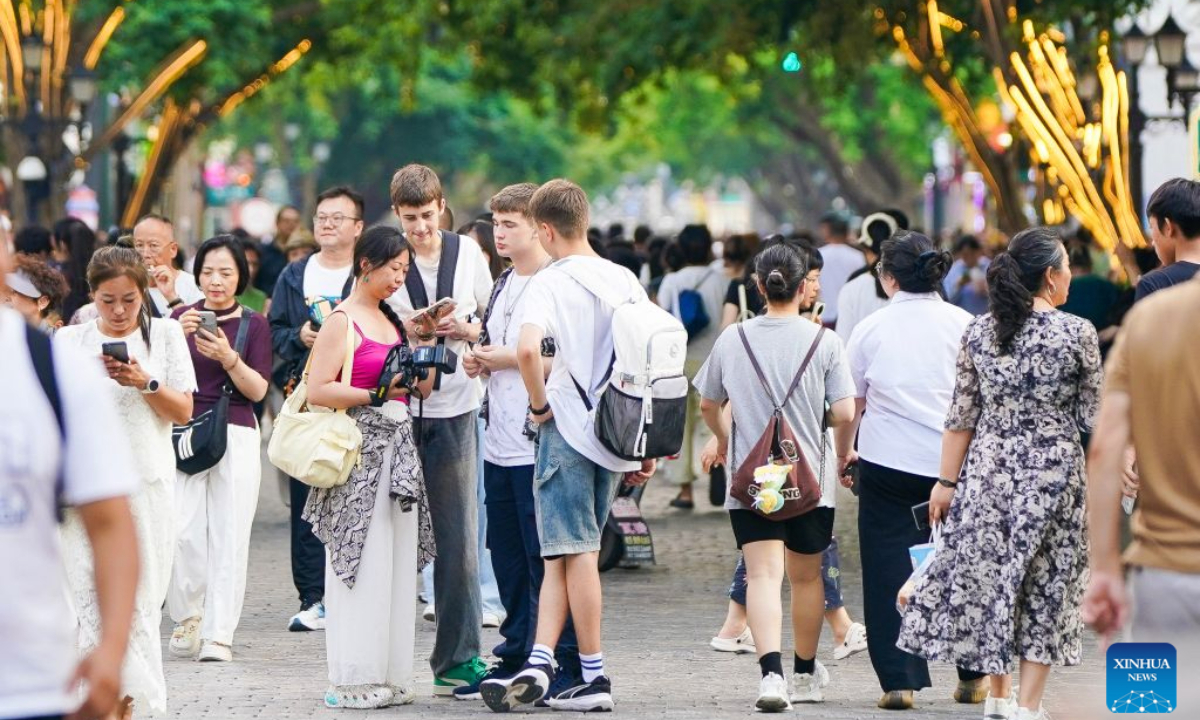
This summer, as heat waves swept across many parts of the world, an increasing number of foreign tourists are heading to China to escape the heat.
In places such as Zhangjiajie in central China's Hunan Province, where mountain scenery creates a natural cooling effect, and the water town in "Jiangnan," the scenic region south of the Yangtze River, where visitors can enjoy the slower pace of life by the canals, cool weather has become part of the travel experience itself. Local specialties and products that help people beat the heat add to the appeal.
But the "cool" in "China Cool" goes beyond the weather. It also comes from the variety of experiences available to visitors. They can listen to the bells of an ancient temple at dawn, learn traditional crafts from artisans, take a high-speed train to another city, or simply order a late-night meal with a few taps on a smartphone. Such everyday experiences showcase China where tradition, convenience and modern life coexist.
That sense of "cool" is even more striking when it comes to technology. Visitors can explore smart factories, try AI glasses with real-time translation, interact with robots, and take autonomous vehicles. For many foreign visitors, these experiences offer a glimpse of China's high-tech future and add a new dimension to the country's image beyond its traditional landmarks.
The growing number of international visitors has also been facilitated by China's efforts to make travel more convenient. According to the National Immigration Administration, China received 22.91 million inbound foreign visitors in the first half of 2026, up 20.4 percent year on year. Visa-free entries accounted for 77.7 percent of this total.
As more visitors arrive and experience the country firsthand, the way China is talked about overseas is also evolving. Phrases such as "China Travel," "Becoming Chinese" and "Chinamaxxing" have gained attention on overseas social media, while "China Cool" offers a new way to capture the broader appeal of these experiences, reflecting interest in China that is no longer experienced only through its famous landmarks, but also through its culture, technology, services and everyday life.
For international visitors, China is proving to be cool in more ways than one.


。

二 |
Current article:http://hottq0c.zongchaeiwengshuabaisisuofu.sbs/list_nepc/tr5oe7.html
Published on:01:40:59